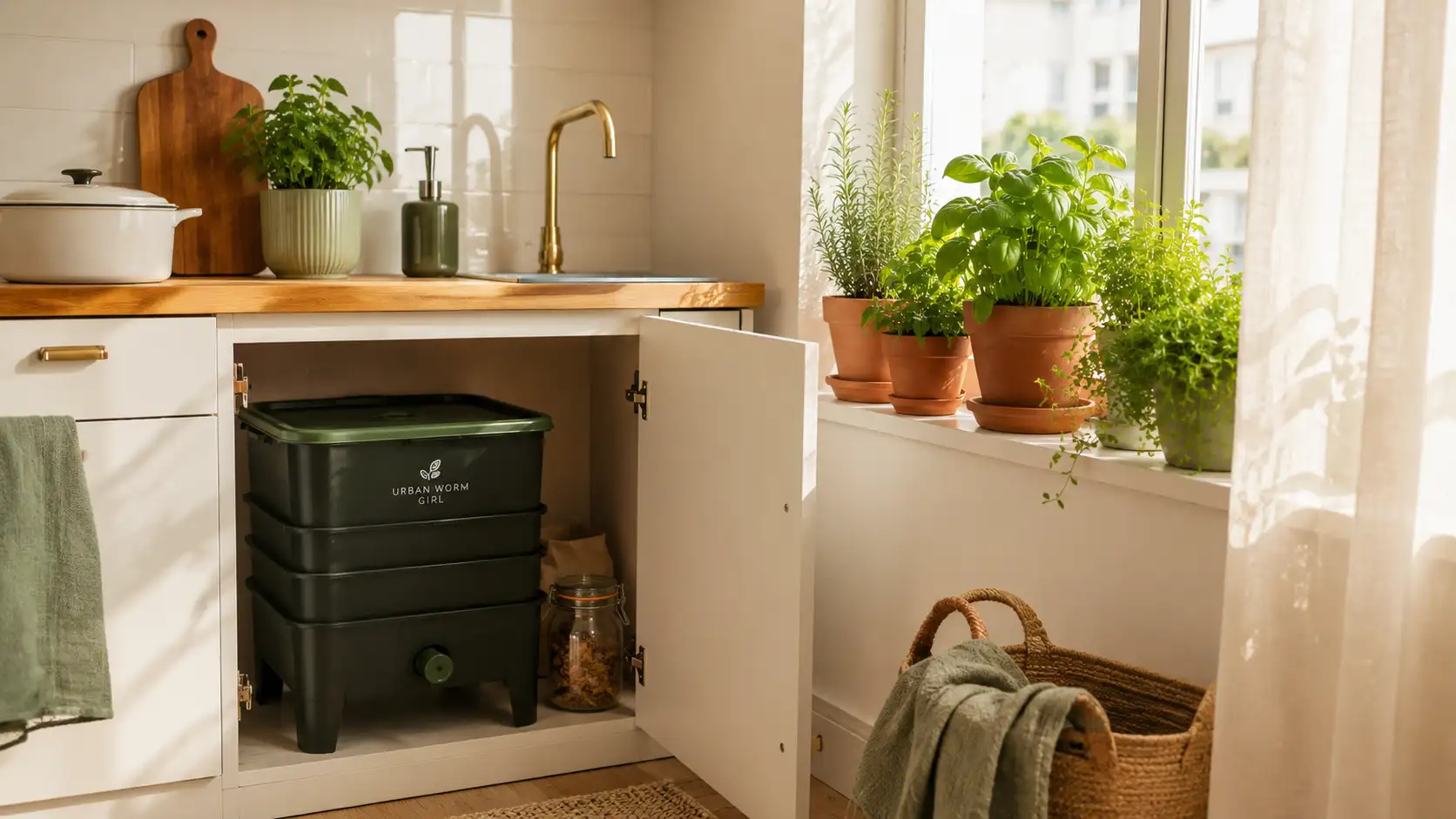
apartment worm composting bin under kitchen sink with herbs

Apartment Worm Composting: The Complete Beginner’s Guide for Small Spaces
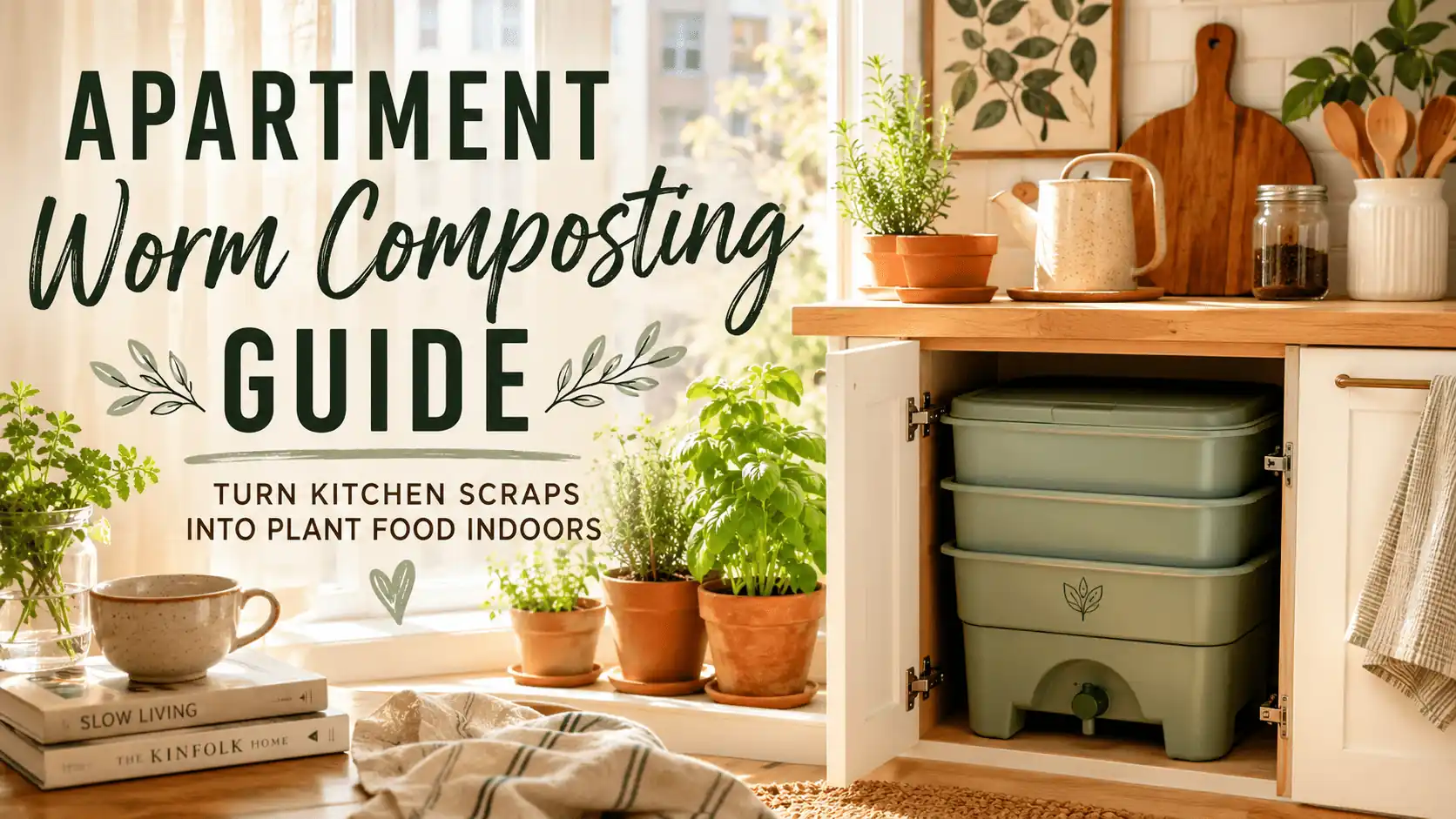
Apartment Worm Composting Guide: How to Turn Kitchen Scraps Into Plant Food Indoors

apartment worm composting guide 2.webp 2
  • How apartment worm composting works
  • Which worms are best for indoor composting
  • How to set up your first worm bin step by step
  • What worms can and cannot eat
  • Common vermicomposting problems and how to fix them
  • How to harvest nutrient-rich worm castings
  • Let's get started.

I used to throw away over half my kitchen scraps every week.
Now almost nothing goes in the trash — and my herbs have never grown better.
Apartment worm composting was the last thing I expected to be doing as a renter.
Like many people, I assumed keeping worms indoors would be messy,
smelly, and far too complicated for a small apartment. I was wrong.
A properly maintained worm bin is surprisingly clean, takes up very little space, and
turns everyday kitchen scraps into one of the best natural fertilizers available.
If you're trying to reduce food waste, grow healthier plants, or embrace apartment homesteading,
apartment worm composting is one of the most rewarding projects you can start.
Unlike traditional compost piles, vermicomposting works entirely indoors. You don't need a backyard, garage, or large balcony.
All you need is a small worm bin, a handful of red wiggler worms, and a little patience.
In this guide, you'll learn:

What Is Apartment Worm Composting?

Apartment worm composting, also called vermicomposting, uses composting worms to break down food scraps and
organic materials into a nutrient-rich fertilizer known as worm castings.
The worms consume food waste and bedding, then convert everything into dark,
crumbly compost packed with beneficial microbes, minerals, and plant-available nutrients.
Everything happens inside a compact indoor bin, making it ideal for:
  • Apartments and studios
  • Condos and tiny homes
  • Renters with no outdoor space
  • Anyone wanting to reduce food waste
worm composting supplies for beginners flat lay

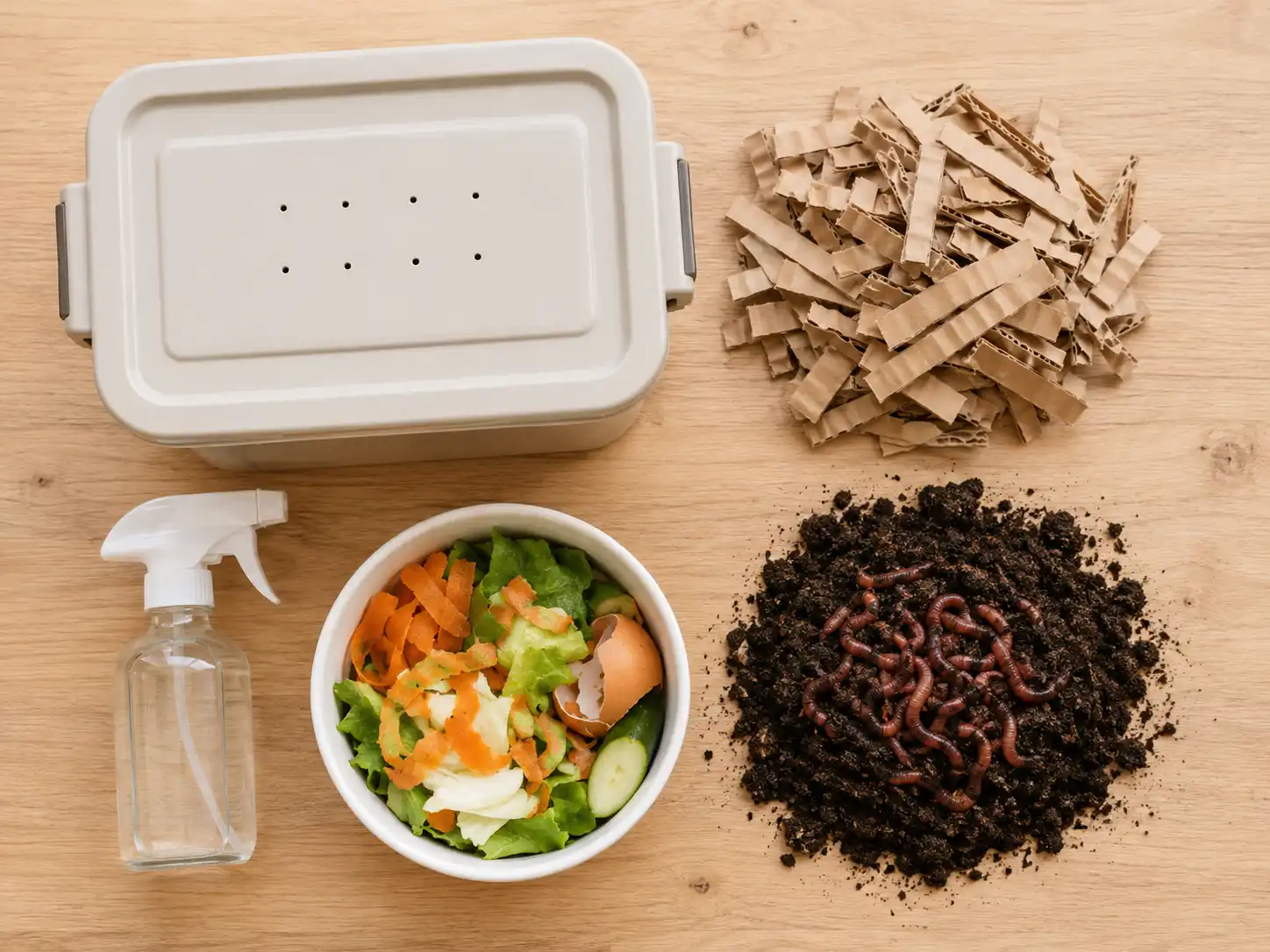
What You Need to Start Apartment Worm Composting

A Worm Composting Bin
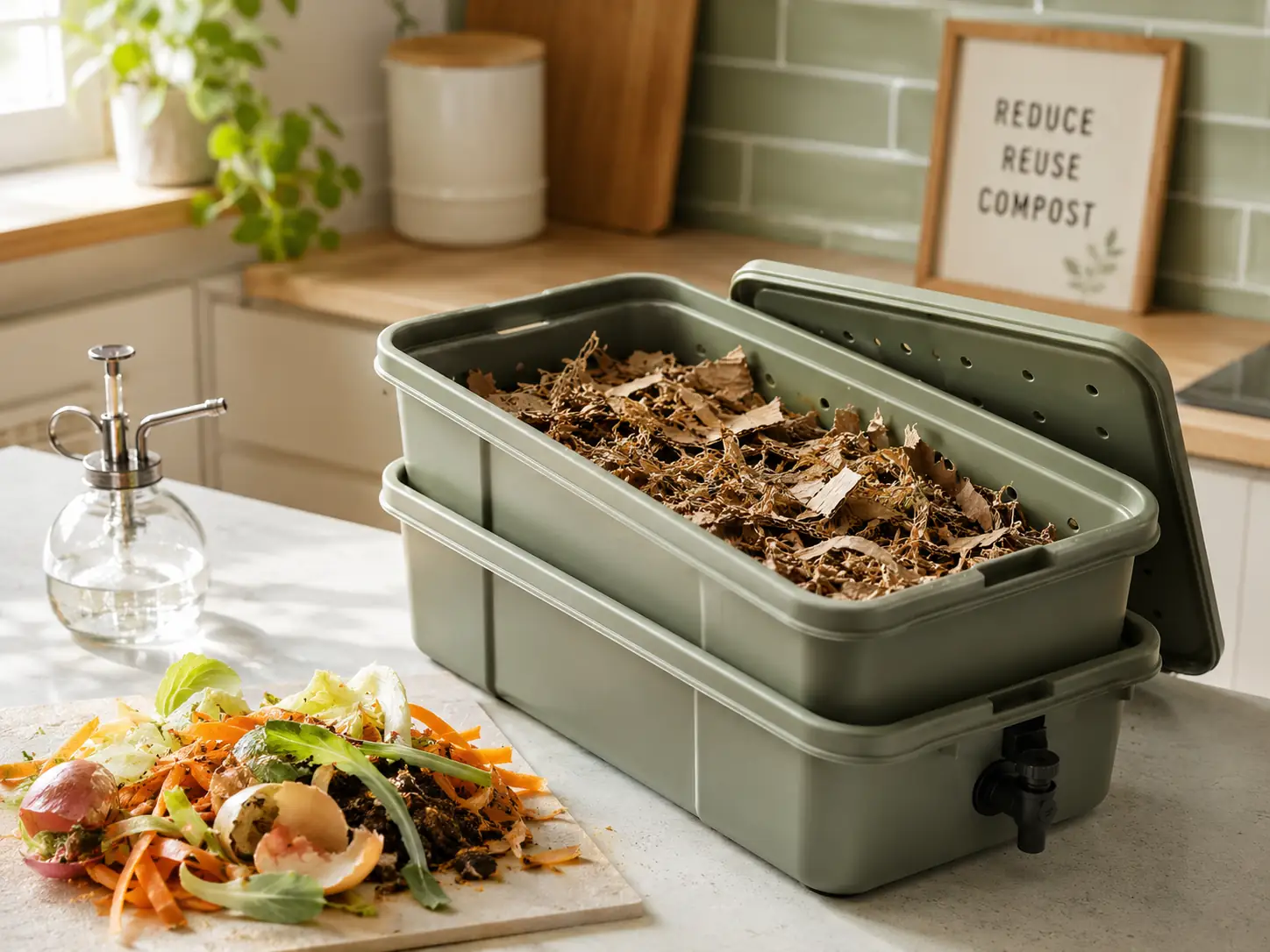
A stackable worm bin works best for apartments. These systems use multiple trays that stack on top of each other.
As worms finish one tray they migrate upward into the next, making harvesting much easier than single-bin systems.
Look for a bin that offers good airflow, a drainage tray, a compact footprint, and easy access for feeding and harvesting.
A 10–20 litre system is enough for most households.

Red Wiggler Worms
Red wigglers are the only worms worth using for indoor composting.
One pound (around 450g) is the right starting amount for most beginners.

Bedding Material
Good bedding options include:

  • Shredded cardboard — free and always available
  • Shredded newspaper, black and white ink only
  • Coconut coir
  • Brown paper bags torn into strips

A Kitchen Scrap Container
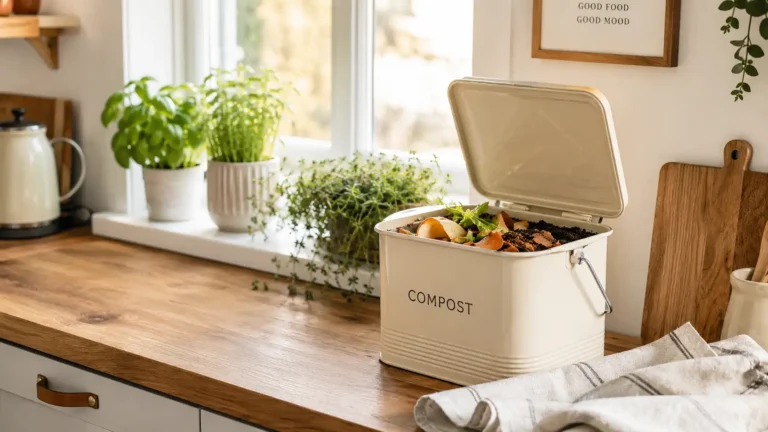
A small countertop container with a lid lets you collect scraps throughout the day.
Empty it into the worm bin every two to three days.

A Spray Bottle
Used to keep bedding at the right moisture level. That's genuinely everything you need to get started.

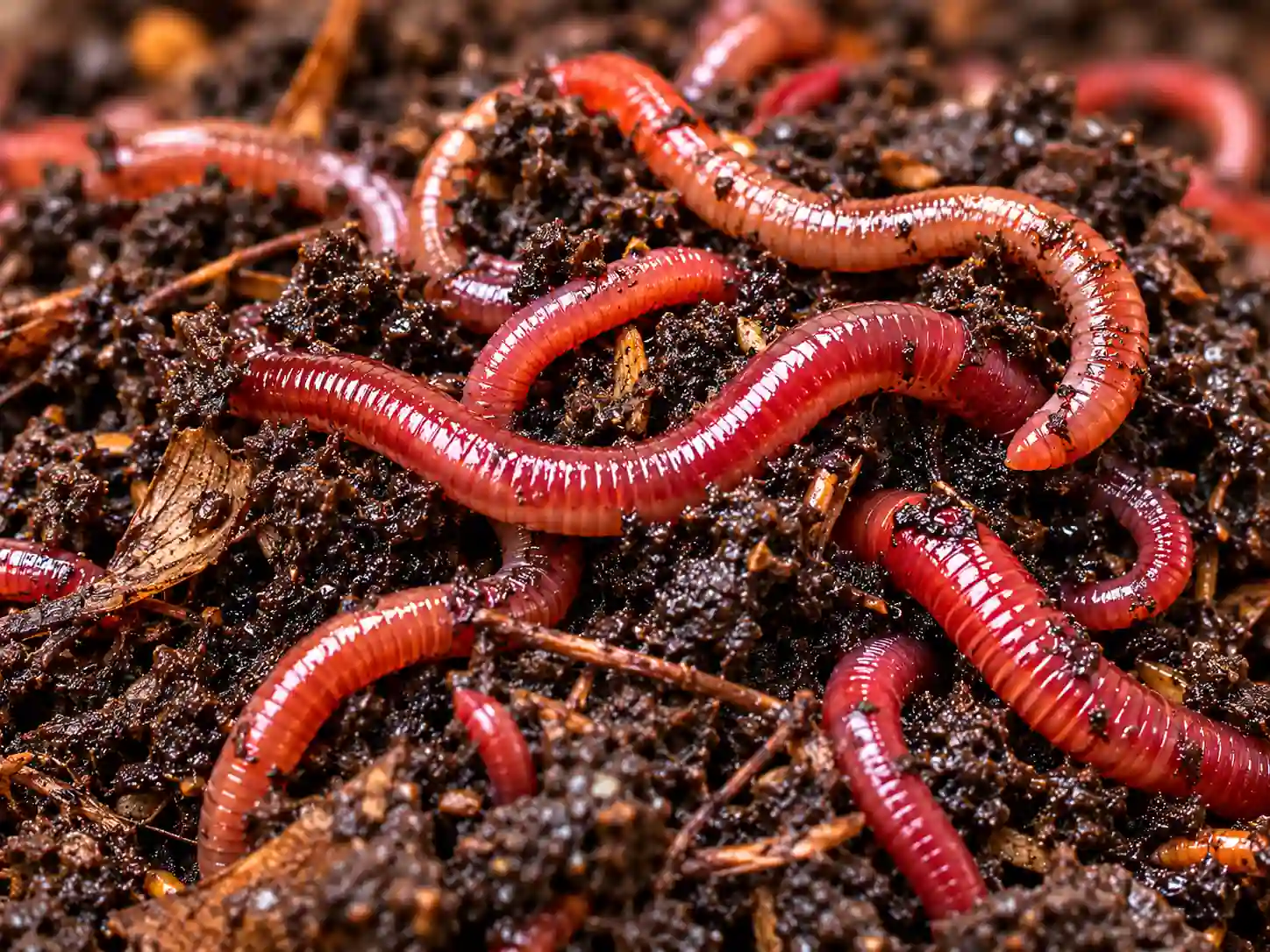
Why Red Wigglers Are the Best Worms for Indoor Composting
red wiggler worms compost.webp

Not all worms are suitable for vermicomposting — using the wrong type is one of the most common beginner mistakes.
Red wigglers (Eisenia fetida) are surface-dwelling worms that naturally live in decaying organic matter —
fallen leaves, rotting logs, compost heaps. They're perfectly adapted to the shallow, food-rich environment of a worm bin.
Here's why they work so well:

  • They process food quickly compared to other worm species
  • They reproduce rapidly, doubling their population roughly every 90 days
  • They thrive in shallow containers rather than deep soil
  • They handle the temperature range found in most apartments
  • They produce high-quality castings rich in plant-available nutrients
  • Never use common garden earthworms or nightcrawlers. These species prefer deep soil environments.
    Placed in a shallow bin they become stressed, stop eating, and often try to escape.
    One pound of red wigglers is enough to process roughly 3–4 pounds of food waste per week once fully established.

How to Set Up Your First Worm Bin

worm bin setup apartment.webp

Setting up your bin correctly from the beginning makes everything easier going forward.
Step 1 — Prepare the Bedding
Shred cardboard or newspaper into strips. Place a thick layer into the bottom tray — around 10–15cm deep.
Dampen it until it feels like a wrung-out sponge — moist throughout but not dripping.
This moisture level matters. Too dry and the worms will struggle. Too wet and the bin becomes smelly.
Step 2 — Add the Worms
Tip your red wigglers onto the surface of the bedding.
They'll naturally burrow downward away from the light.
Leave the lid off for the first 30 minutes to encourage them to settle deeper rather than escape over the edges.
Step 3 — Add a Small First Feeding
Start with just a handful of food scraps. Bury it beneath the bedding rather than leaving it on the surface.
Overfeeding in the first few weeks is the single most common beginner mistake and the main cause of smelly bins.
Step 4 — Cover the Food
Always bury food scraps under a layer of bedding.
This prevents fruit flies from finding the food and significantly reduces odours.
A handful of dry shredded cardboard on top of every feeding works perfectly.
Step 5 — Monitor Moisture Regularly
Check the bin every couple of days in the first few weeks. If bedding is drying out, mist with a spray bottle.
If it's getting too wet, add more dry shredded cardboard. Once you find the right rhythm —
usually within two to three weeks — maintenance becomes second nature.

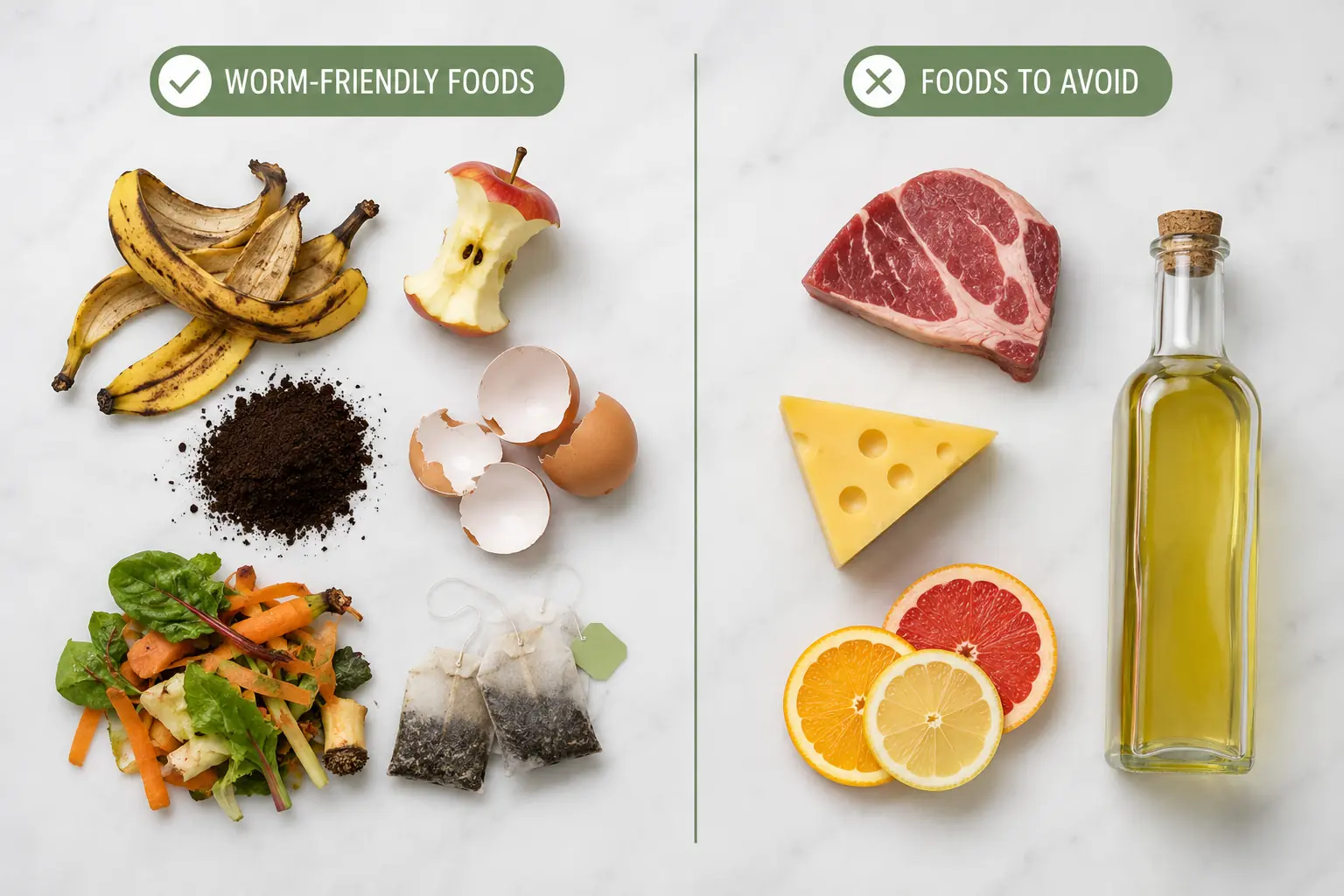
What Can Worms Eat?
worm foods to eat avoid.webp

Feeding your worms correctly is essential for a healthy, odour-free bin.

Foods Worms Love
  • Fruit peels and cores such as apple, pear, mango, and banana
  • Vegetable scraps including carrot tops, lettuce, cucumber, and courgette
  • Coffee grounds and paper filters
  • Tea leaves and bags with staples removed
  • Crushed eggshells
  • Melon rinds and pumpkin
  • Cooked plain rice or pasta in small amounts
  • Bread in small amounts
  • Soft, moist foods break down fastest. Harder materials like carrot stems will break down eventually but take longer.


    Foods to Avoid
  • Meat and fish — decompose slowly and create strong odours indoors
  • Dairy products — attract pests and create unpleasant smells
  • Oily or greasy foods — coat the worms and interfere with their skin
  • Salty foods — dehydrates worms and can be fatal in large amounts
  • Large amounts of citrus — increases bin acidity to levels worms dislike
  • Spicy foods like onion or garlic — worms actively avoid these
  • A Note on citrus

    Small amounts are fine. The problem is when citrus makes up a large proportion of your scraps over time, gradually acidifying the bin.
    Balance it with crushed eggshells, which are alkaline and help neutralise acidity naturally.

    A Note on Meat and Dairy

    Worms can eventually break these down, but the smell they create during indoor decomposition makes them impractical for apartment vermicomposting.
    Leave them out entirely and your bin will stay odour-free.

    Best Places to Keep a Worm Bin in an Apartment

    Location affects how well your bin performs and how easy it is to maintain. The ideal spot is convenient, temperature-stable, and away from direct sunlight.

  • Under the kitchen sink — most popular choice, close to food prep, stays cool
  • Pantry corner — out of the way with good temperature stability
  • Utility or laundry room — slightly more out of the way but still convenient
  • Covered balcony — works well in mild climates, avoid if temperatures drop below 10 degrees Celsius
    Locations to Avoid
  • Direct sunlight — overheats the bin and stresses the worms
  • Near heating vents or radiators — too warm and dries bedding quickly
  • Unheated spaces in winter — below 10 degrees Celsius slows composting significantly
  • Ideal Temperature Range

    Red wigglers are most productive between 55°F and 77°F (13°C and 25°C). Most apartments naturally stay within this range year-round — which is one of the main reasons apartment worm composting works so well indoors.


Common Worm Composting Problems and How to Fix Them
Every beginner runs into at least one issue. Here's how to solve the most common problems quickly.
Problem: Bad Smell
A healthy worm bin should smell earthy — like fresh soil after rain. If yours smells rotten, something needs attention.
Causes: Too much food, bin too wet, poor airflow.
Fix: Stop feeding for one week. Add dry shredded cardboard. Mix the bedding gently to improve airflow. The smell should clear within a few days.
Problem: Fruit Flies
Fruit flies appear when food scraps are left exposed on the surface.
Fix: Always bury food under bedding. For an existing infestation, freeze scraps for 24 hours before adding them — this kills any eggs already in the food. A dry cardboard layer on top of every feeding acts as a permanent barrier going forward.
Problem: Worms Trying to Escape
Worms stay put when conditions are comfortable. If they're leaving, the environment is off.
Causes: Bin too wet, too acidic, or wrong temperature.
Fix: Check moisture levels. Reduce acidic foods. Add crushed eggshells to balance pH. Move the bin to a more stable location.
Problem: Bin Too Wet
A soggy bin slows composting and can become smelly.
Fix: Add several handfuls of dry cardboard and leave the lid slightly open for a day. Going forward, add dry cardboard with every feeding to absorb liquid from fresh scraps.
Problem: Worms Not Eating
Scraps sitting uneaten for more than a week means the worms need more time to settle or the food is too hard or dry.
Fix: Chop or blend scraps into smaller pieces. Check bedding moisture. Be patient — new worm populations often take two to four weeks to reach full productivity.

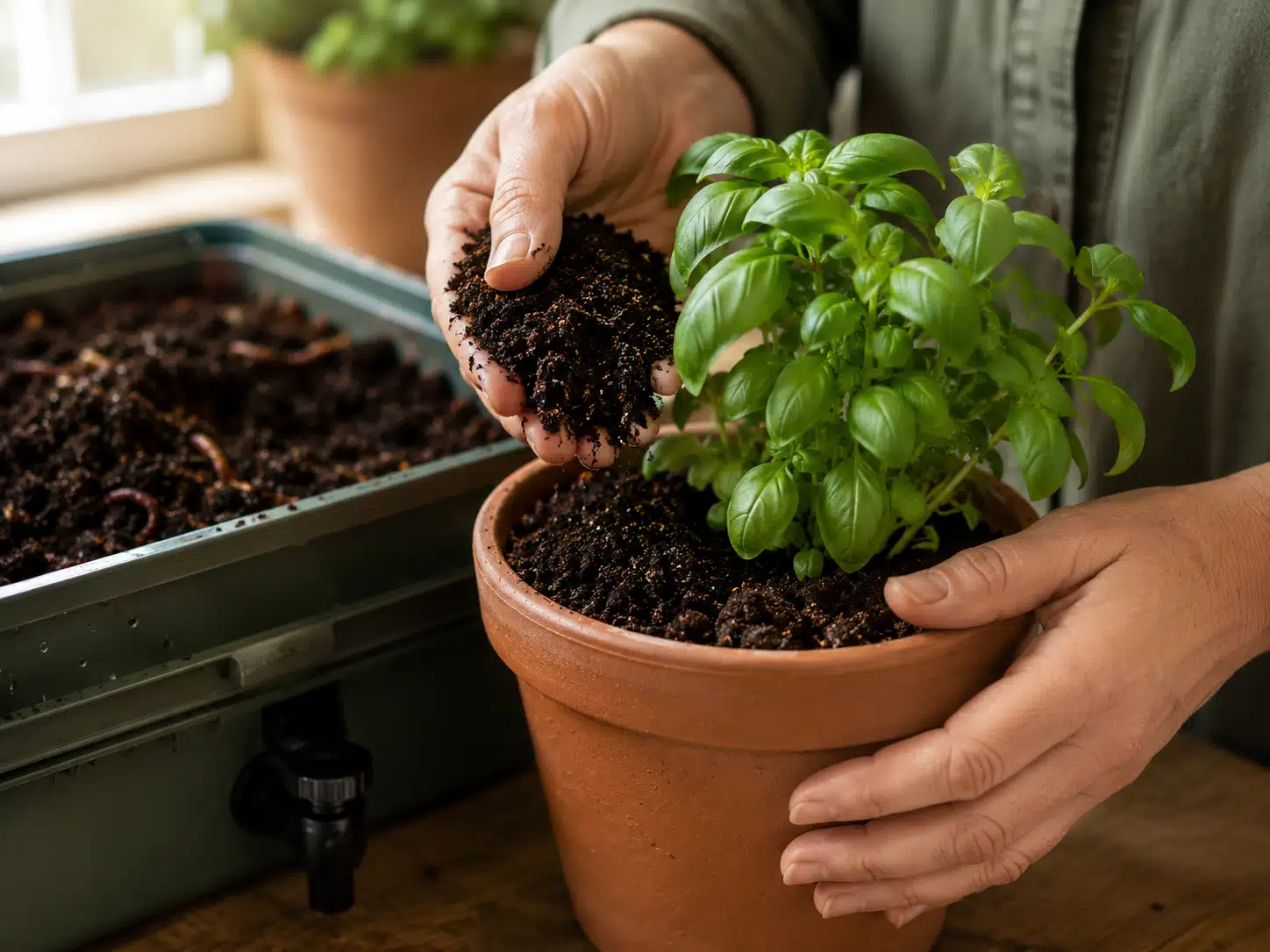
How to Harvest Worm Castings
harvesting worm castings.webp

Harvesting is the most satisfying part of vermicomposting.
After two to four months your bin will contain dark, crumbly, nutrient-rich castings ready for your plants.

    Method 1 — Side Migration (Single Bin)

  1. Push all existing bedding and compost to one side of the bin
  2. Add fresh damp bedding and food scraps to the empty side
  3. Wait two to three weeks
  4. Worms migrate naturally toward the fresh food
  5. The original side will be mostly worm-free and ready to harvest
  6. Scoop out the castings and refill that side with fresh bedding
  7. Method 2 — Tray Migration (Stackable Bins)

    As worms finish one tray they migrate upward through the mesh floor into the next tray where fresh food has been added. After a few weeks the lower tray contains finished castings with very few worms remaining. Simply remove the bottom tray, collect the castings, clean it, and place it on top of the stack as the new feeding tray.

    How to Use Worm Castings

  • Mix one part castings with four parts potting soil for containers
  • Top herb and vegetable pots with a thin layer each month
  • Add a handful to seed-starting mix for stronger germination
  • Mix into houseplant soil during repotting
  • Even a small worm bin produces enough castings to keep a windowsill herb garden fed and thriving year-round.

Worm Composting vs Other Apartment Composting Methods

Not sure whether vermicomposting is right for your apartment?
Here's how it compares to the other main indoor composting options:
MethodSmell LevelCostBest For
Countertop BinLow$20 to $40Beginners who just need scrap storage
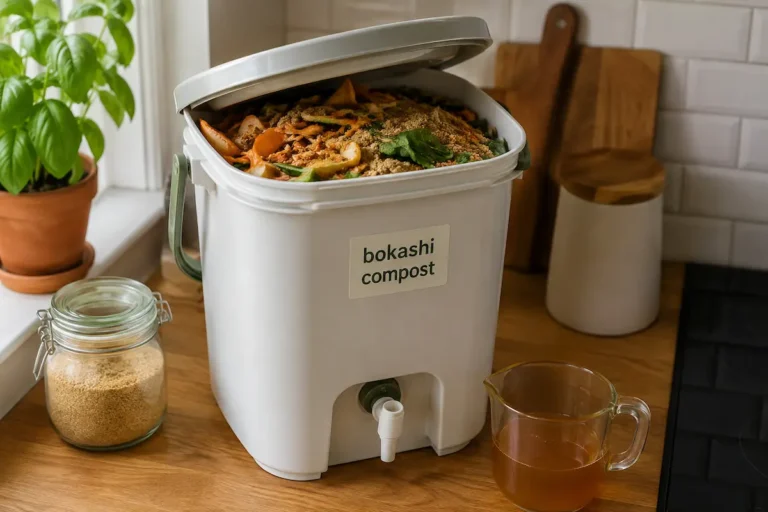
BokashiVery Low$40 to $70Composting meat and dairy indoors
VermicompostingEarthy$50 to $80Indoor gardeners who want finished fertilizer

Is Worm Composting Worth It for Apartment Dwellers?

For most apartment homesteaders, the answer is a clear yes.

You reduce food waste significantly. A worm bin intercepts almost all organic kitchen waste and turns it into something genuinely useful.

You create free, high-quality fertilizer. Store-bought organic fertilizers are expensive and come in plastic packaging. Worm castings are free, continuous, and produced right in your home.

Your plants grow noticeably better. Worm castings are rich in beneficial microbes, humic acids, and plant-available nutrients. Many gardeners notice a visible difference within weeks of using them.

You build sustainable habits that last. Apartment homesteading is about small, consistent actions that add up over time. Worm composting fits naturally into that lifestyle — once the bin is established, maintaining it takes only a few minutes each week.

Frequently Asked Questions

Does apartment worm composting smell?

No. A healthy worm bin smells earthy — similar to fresh soil or a woodland floor. Bad smells only develop when the bin is overfed, too wet, or poorly ventilated, all of which are straightforward to prevent and fix.

Can I keep worms in a small apartment?

Absolutely. Many systems fit comfortably under a standard kitchen sink and take up less than half a square metre of floor space.

How many worms do I need to start?

One pound (around 450g) of red wigglers is the right starting amount for most households of one to two people.

How long does it take to produce worm castings?

Typically two to four months for the first harvest, depending on your feeding habits and bin conditions. Once established, your bin produces castings continuously.

Do worm bins attract pests?

Not if managed correctly. Burying food scraps, avoiding meat and dairy, and keeping the lid on prevents flies, ants, and other pests in the vast majority of cases.

Can I leave the worm bin if I go on holiday?

Yes. A well-established bin can be left for two to three weeks without feeding. Add extra bedding before you leave and give the worms a larger than usual feeding and the bin will be fine while you are away.

Final Thoughts

Apartment worm composting may sound unusual at first, but it is one of the most efficient and rewarding ways to recycle kitchen scraps in a small space.

With the right setup, you can create nutrient-rich compost, reduce food waste, and support healthier plants — all without needing a backyard.

Start small, be patient, and let the worms do the work.

Every banana peel, coffee ground, and vegetable scrap you compost is one less item heading to landfill and one more resource helping your plants thrive.

Found this guide helpful?

Save it to your Apartment Homesteading Pinterest board so you can find it later.

Ready to put your worm castings to work? Read our Windowsill Herb Garden Guide next and discover how to grow fresh herbs indoors using your finished compost.

Similar Posts

Leave a Reply

Your email address will not be published. Required fields are marked *