Fermented Pickles (Real Lacto-Fermented Dill Pickles, No Vinegar)
Most pickles sold in a grocery store aren’t actually fermented — they’re cucumbers preserved in a vinegar solution, which delivers sourness instantly with no bacteria involved at all — our quick pickled red onions recipe uses that same fast vinegar method, and so do our refrigerator dill pickles if you want a quick cucumber version. Real fermented pickles work differently: cucumbers sit in a plain salt brine, and the Lactobacillus bacteria already living on their skins convert the natural sugars into lactic acid over days or weeks. That process is what gives lacto-fermented pickles their distinct tang, their crackling crunch, and a living population of probiotics that a vinegar pickle never develops. If a jar of “fermented pickles” at the store lists vinegar in the first few ingredients, it isn’t one — genuinely fermented pickles are almost always sold refrigerated, never shelf-stable.
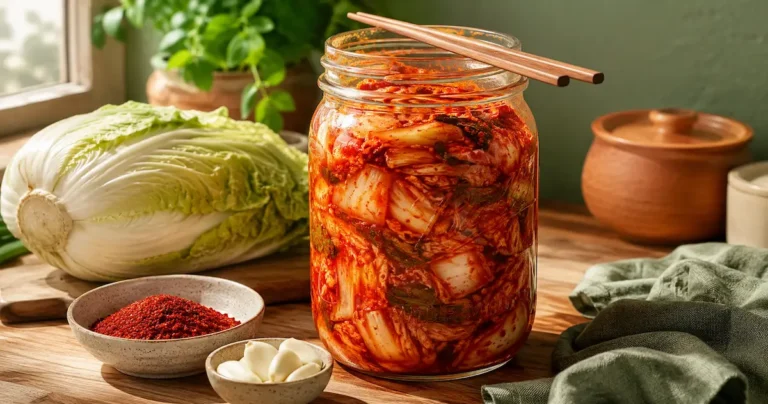
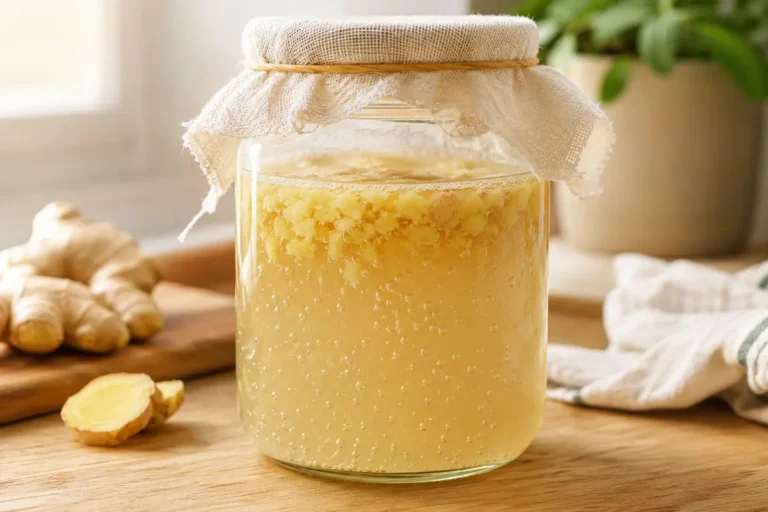
This site already covers sauerkraut and kimchi, both built on the same lacto-fermentation principle. Pickles use the identical bacteria and the identical basic mechanism — salt, time, and the right conditions — just applied to whole or sliced cucumbers instead of shredded cabbage. The same wild-fermentation logic also works on liquids rather than vegetables — a ginger bug is the drink-soda version of this same idea.
Getting the salt ratio right actually matters
Most recipes online tell you to use a fixed amount of salt per quart of water — commonly 1 to 3 tablespoons — and that works fine for a lot of batches. But it’s an approximation, and it’s the reason some people’s pickles turn out perfectly crisp while an identical-looking batch goes soft or moldy. The bacteria doing the fermenting need a specific salt concentration relative to the total weight of what’s in the jar, not just the water.
The more reliable method: weigh your empty jar, then weigh it again once packed with cucumbers and water, and calculate salt as 3% of that total submerged weight. For a jar with 1000g combined cucumber-and-water weight, that’s 30g of salt — a small kitchen scale makes this a 30-second step, and it’s the difference between guessing and actually controlling the fermentation. If you don’t have a scale, the simpler volume method (2 tablespoons of salt per quart of water) is a reasonable default and what most of this recipe is written around — just know the percentage method is what to switch to if you’re getting inconsistent results between batches.
Whichever method you use, the salt has to be plain — no iodized table salt, which interferes with the fermentation bacteria. Kosher salt, canning salt, or sea salt all work.
Ingredients
| Ingredient | Amount |
|---|---|
| Small pickling cucumbers (Kirby or similar) | 1.5 lbs |
| Water, filtered or dechlorinated | 4 cups |
| Non-iodized salt | 2-3 tbsp (or 3% by weight — see above) |
| Garlic cloves, peeled | 4-6 |
| Fresh dill, flowering heads or fronds | 2-3 sprigs |
| Grape, oak, or bay leaves (for crispness) | 2-3 leaves |
| Black peppercorns, optional | 1 tsp |
Small, firm cucumbers matter more than people expect — larger slicing cucumbers have more water content and a higher chance of turning soft during a multi-week ferment. If tap water in your area is heavily chlorinated, let it sit out uncovered for a few hours first; residual chlorine can slow or inhibit the fermentation bacteria the same way it does in a fish tank.
The grape, oak, or bay leaves aren’t decorative — they’re a real source of tannins, and tannins are what help keep the pickles’ cell walls firm through a long ferment. Black tea leaves work as a substitute if none of those are available.
Choosing a vessel: jar vs. crock, sealed vs. open-air
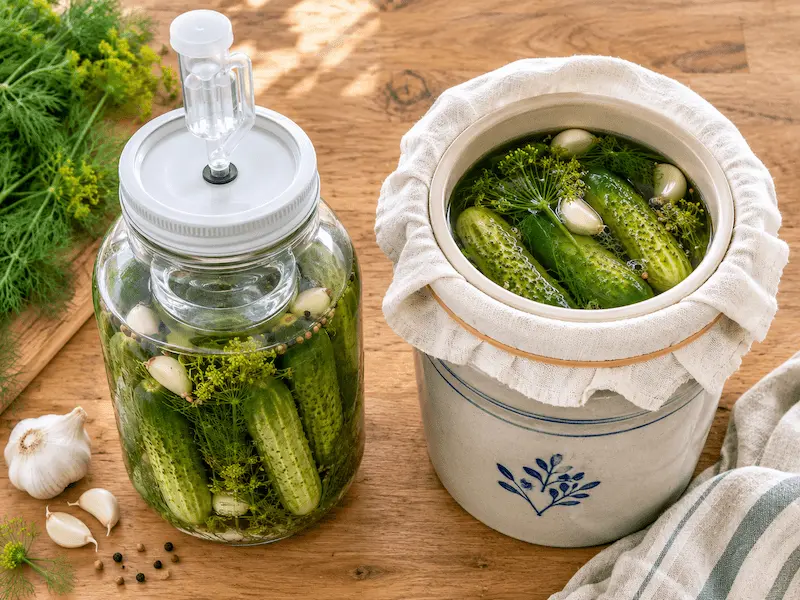
A wide-mouth mason jar works fine for a small batch and is the easiest starting point. A ceramic fermentation crock handles a larger batch more comfortably and is the traditional choice, but it isn’t required for good results.
Separately from the vessel, there’s a choice between open-air and sealed fermentation. Open-air means covering the jar loosely with cloth or a coffee filter secured by a rubber band, which lets gas escape freely but leaves more exposure to airborne contaminants. Sealed fermentation uses an airlock lid, which lets built-up carbon dioxide vent out without letting air back in — more protection against mold, at the cost of an extra piece of equipment. Either genuinely works; airlock lids are worth the small cost if you plan to ferment regularly, but a jar with a loose lid you “burp” daily by cracking it open to release pressure is a fine way to start.
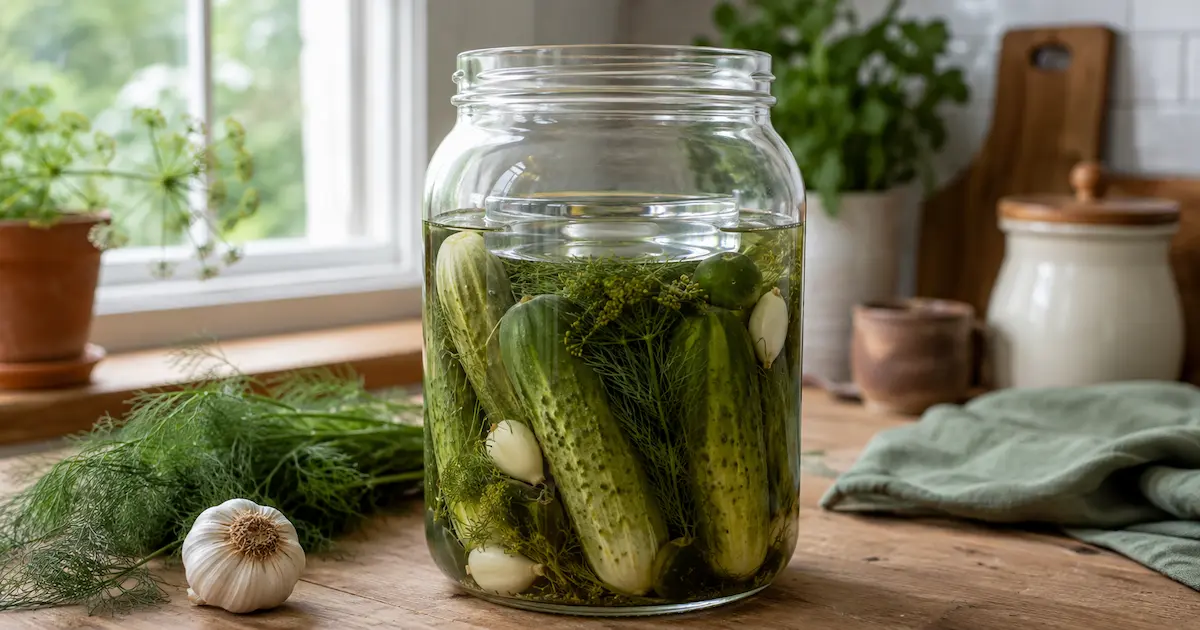
Whatever vessel you use, a fermentation weight is not optional. Any cucumber that floats above the brine line is exposed to air, and that’s where mold actually starts — a small glass or ceramic weight (or even a smaller jar filled with water, wedged into the mouth of the larger one) keeps everything submerged.
Packing and brining
Trim ¼ inch off the blossom end of each cucumber — the end opposite the stem. That end carries an enzyme that softens pickles over a long ferment, and removing it is a small step that meaningfully improves the odds of a crisp result. Leave cucumbers whole for classic dill pickles, or cut into spears if you’d rather.
Layer the garlic, dill, and tannin leaves in the bottom of the jar, pack the cucumbers in tightly on top, and add any remaining spices. Dissolve the salt fully into the water to make your brine — warm water speeds up dissolving, but let it cool to room temperature before pouring so you don’t accidentally start cooking anything. Pour the brine over the cucumbers until fully submerged, leaving an inch or two of headspace, then add your weight and seal or cover.
Fermenting and monitoring
Set the jar somewhere cool, dark, and out of direct sunlight — a pantry or cupboard works better than a sunny counter. Fermentation speed depends heavily on temperature: a warm kitchen (75°F+) can produce a lightly fermented “half-sour” pickle in as little as 3 to 5 days, while a cooler spot (60-65°F) stretches a fuller ferment out to 2 to 4 weeks.
If you’re using a loosely covered jar rather than an airlock, check daily and “burp” it — unscrew the lid briefly to release built-up gas, then reseal, without disturbing the weight or the submerged cucumbers underneath. Cloudy brine, tiny bubbles rising through the liquid, and a gradual color shift from bright to olive-green are all normal signs fermentation is actively happening, not signs of a problem.
Start tasting around day 3 or 4. Once they’ve reached a sourness you like, move the jar to the fridge — cold temperatures dramatically slow the fermentation without stopping it entirely, which is how you “lock in” the flavor at the point you want rather than letting it continue indefinitely.
Half-sour vs. full-sour
- Half-sour: shorter ferment (3-7 days), lower salt concentration, lighter tang, still very crisp and a bit closer in flavor to a fresh cucumber. Popular deli-style pickle.
- Full-sour: longer ferment (2-4+ weeks), higher salt concentration (closer to ¼ cup per quart rather than 2 tablespoons), deeper tang and more developed sourness, softer texture by the end than a half-sour.
Neither is more “correct” — it comes down to preference, and the salt amount and timeline above give you either depending on how long you let the jar go and how much salt you use going in.
Telling mold from harmless kahm yeast
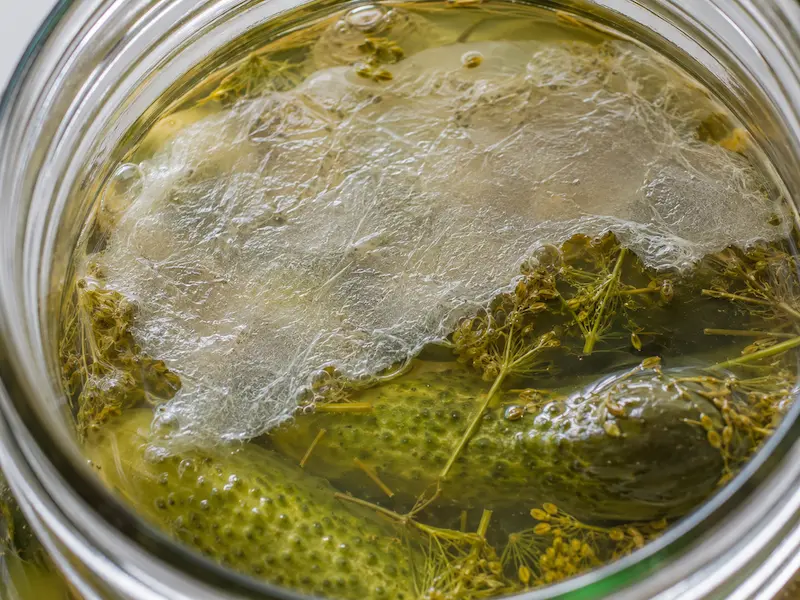
This is the single most common point of anxiety for a first-time fermenter, and it’s worth being specific about rather than vague. Kahm yeast is a thin, flat, dull-white or cream-colored film that can form on the brine’s surface — it’s harmless, a byproduct of a healthy ferment exposed to air, and can simply be skimmed off the top before continuing. Mold looks distinctly different: fuzzy, raised, and colored — green, black, pink, or blue rather than flat white. If you see actual mold, especially anything colored or fuzzy, discard the batch rather than trying to skim around it; mold’s roots can extend into the liquid in ways that aren’t visible on the surface.
The best prevention for both is the same: keep every cucumber fully submerged under the weight, since anything poking above the brine line is what invites either one to begin with.
Where this goes wrong
| Problem | Likely cause | Fix |
|---|---|---|
| Pickles turned soft or mushy | Blossom end not trimmed, no tannin leaves used, or cucumbers too large/watery | Trim the blossom end, add grape or oak leaves next batch, use small firm cucumbers |
| Colored, fuzzy growth on the surface | Actual mold, usually from a cucumber floating above the brine | Discard the batch; use a proper weight to keep everything submerged next time |
| Thin white film, no fuzz or color | Harmless kahm yeast | Skim it off the surface and continue fermenting |
| No sourness developing after several days | Kitchen too cold, or iodized salt used | Move to a warmer spot; confirm the salt used has no iodine added |
| Brine overflowed out of the jar | Not enough headspace left before sealing | Leave 1-2 inches of headspace, and set the jar in a bowl to catch overflow during active fermentation |
Storing
Once refrigerated, fermented pickles keep well for 1 to 2 months, sometimes longer, continuing to slowly develop flavor even in the cold. Save the leftover brine once the pickles are gone — strained and refrigerated, it works as a tangy addition to salad dressings, or as a flavor boost stirred into the brine of your next batch.
FAQ
Are pickles fermented?
Not automatically — it depends how they’re made. Most grocery-store pickles are preserved in vinegar and never fermented at all. True fermented pickles use only salt brine and rely on naturally occurring bacteria to produce sourness over time; they’re almost always sold refrigerated rather than shelf-stable, which is one way to tell the difference at the store.
What’s the difference between this and a quick vinegar pickle?
A vinegar pickle gets its sourness immediately from added acid and can be eaten within hours. A lacto-fermented pickle develops its sourness slowly through bacterial fermentation over days or weeks, and picks up live probiotics along the way that a vinegar pickle never develops.
Can I use this same method for other vegetables?
Yes — the same salt-brine principle behind this lacto fermented dill pickle recipe works for carrots, green beans, cauliflower, and radishes, generally at the same rough salt ratio.
Why did my brine turn cloudy?
Normal. Cloudiness is a visible sign of active bacterial fermentation, not spoilage.
Do I need special equipment to get started?
No — a mason jar, a small weight (even a smaller jar filled with water works), and a loose lid you burp daily is enough for a first batch. An airlock lid is a nice upgrade if you end up fermenting regularly.