Pickled Banana Peppers (Easy Refrigerator Recipe)
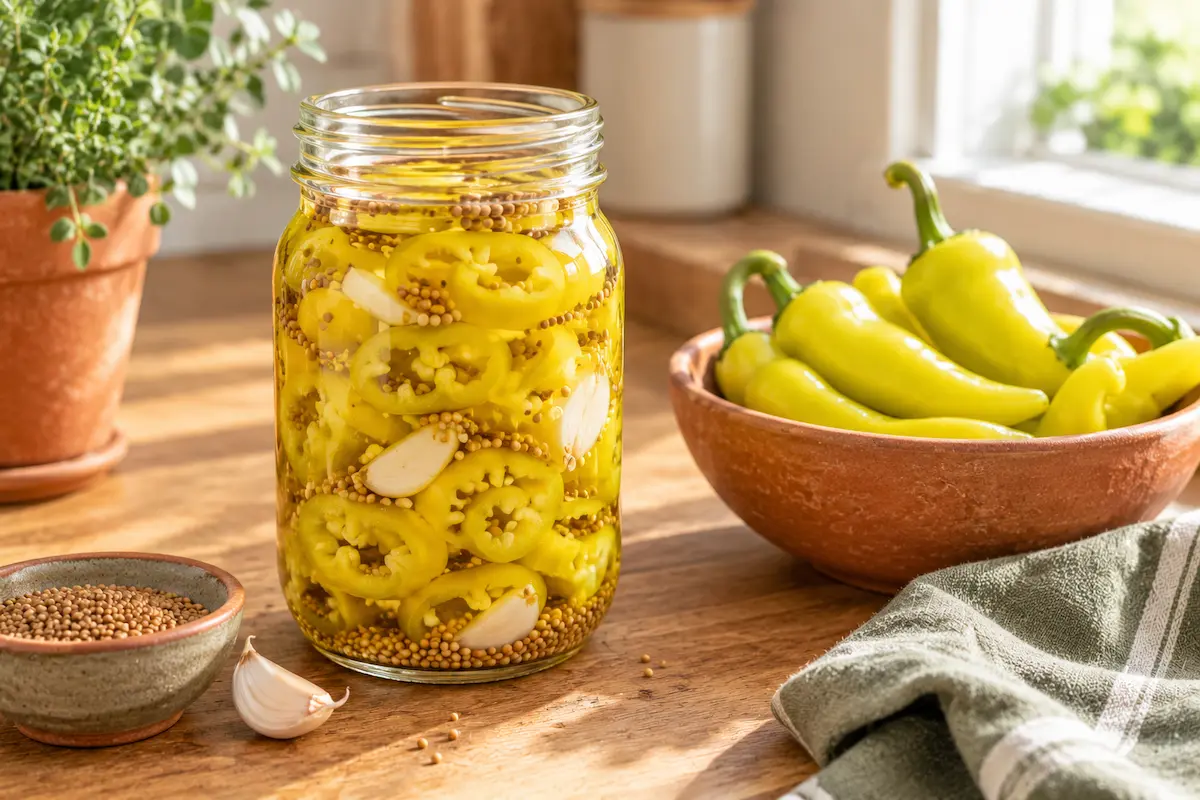
Pickled banana peppers are the tangy, slightly sweet rings that pile onto sandwiches, subs, and pizza, and they are one of the easiest vegetables to pickle at home. This version uses the refrigerator method: slice the peppers, pack a jar, pour hot vinegar brine over them, and let the fridge do the rest. There is no water bath and no canning equipment, just about 15 minutes of hands-on time, which suits a small apartment kitchen.
Peppers are a low-acid vegetable, so the details matter more than they look. These pickled banana peppers are written for the refrigerator only. They are not shelf-stable, and the 1:1 brine below is not a canning brine (the section on canning explains why). Follow the brine ratio and storage notes as written and you get a crisp, tangy jar that is ready to eat in a day.
Recipe at a glance
- Makes: one 1-quart jar (about 1 lb of peppers)
- Hands-on time: about 15 minutes
- Wait time: at least 24 hours, better after 3-5 days
- Keeps: best within 2-4 weeks, refrigerated the entire time
Ingredients for Pickled Banana Peppers
For one 1-quart (32 oz) jar:
- 1 lb banana peppers (about 8 to 10 medium), stems removed
- 1 cup distilled white vinegar, labeled 5% acidity
- 1 cup water
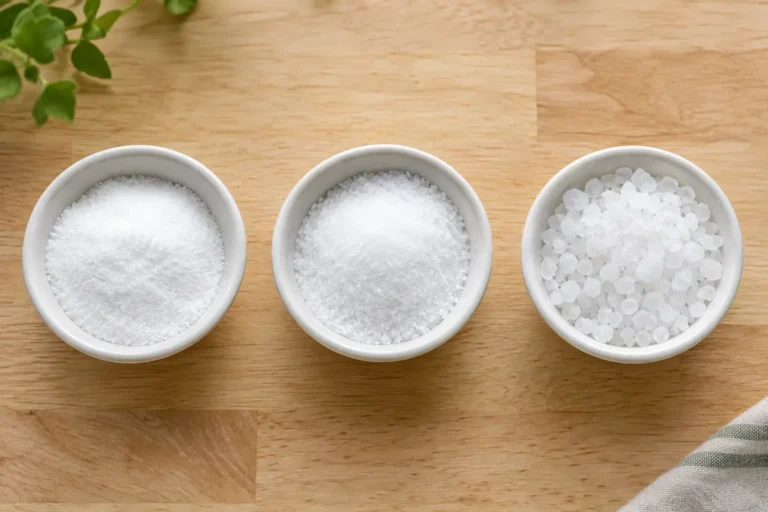
- 1 tablespoon pickling salt (weigh it if you use a different salt, since kosher and sea salts are much lighter by volume). See our pickling salt guide for how it compares to table salt.
- 1-2 tablespoons sugar, to taste
- 2 garlic cloves, peeled and lightly smashed
- 1 teaspoon mustard seeds
- 1 teaspoon whole black peppercorns
- Optional: 1 bay leaf, 1/4 teaspoon celery seed, or a pinch of red pepper flakes
Choosing Banana Peppers: Sweet vs. Hot
Grocery stores often sell two different peppers under the name banana pepper, and the difference matters for your jar. True sweet banana peppers are very mild. Hot banana peppers, which are usually Hungarian wax peppers, look almost identical but can be as hot as a jalapeno or hotter.
| Pepper | Looks like | Heat (Scoville units) | Best for |
|---|---|---|---|
| Sweet banana pepper | Pale yellow, ripening to orange and red | About 0-500 (very mild) | Sandwiches, salads, anyone avoiding heat |
| Hot banana pepper (usually Hungarian wax) | Nearly identical, often with thicker flesh | Roughly 1,000-15,000, commonly cited around 5,000-10,000 | Pizza, nachos, a jar with real kick |
| Jalapeno (for comparison) | Dark green, shorter and rounder | About 2,500-8,000 | A reference point for how hot is hot |
Heat varies by plant and ripeness, so treat these ranges as a guide rather than a guarantee.
Because the two look so alike, taste a small raw slice before you pickle a batch if the label does not say which one you have. Pickling mellows heat a little, but it will not turn a hot pepper mild. Wear gloves when slicing anything hotter than mild, and keep your hands away from your eyes until you have washed them.
For classic sandwich-shop pickled banana peppers, choose the sweet type. Pick peppers that are firm, glossy, and free of soft spots or wrinkles. Peppers that are already going limp will pickle limp, so use them within a few days of buying.
Equipment
You do not need special gear to make pickled banana peppers, just a few kitchen basics:
- A clean 1-quart glass jar with a lid. Vinegar corrodes bare metal, so use a plastic or coated lid, or put a layer of plastic wrap between the jar and a metal lid.
- A stainless steel or enamel saucepan. Avoid aluminum, cast iron, and copper, which can react with the vinegar and discolor the brine.
- A sharp knife, a cutting board, measuring cups and spoons, and disposable gloves if your peppers are on the hot side.
How to Make Pickled Banana Peppers
- Clean the jar. Wash the jar and lid in hot, soapy water and rinse well. The jar does not need to be sterilized because the peppers stay refrigerated, but it should be spotless.
- Slice the peppers. Wash the peppers, cut off the stems, and slice into rings about 1/4 inch thick. Keep the seeds in for a little more heat, or scrape them out for a milder jar. Cut the rings evenly so they soften at the same pace.
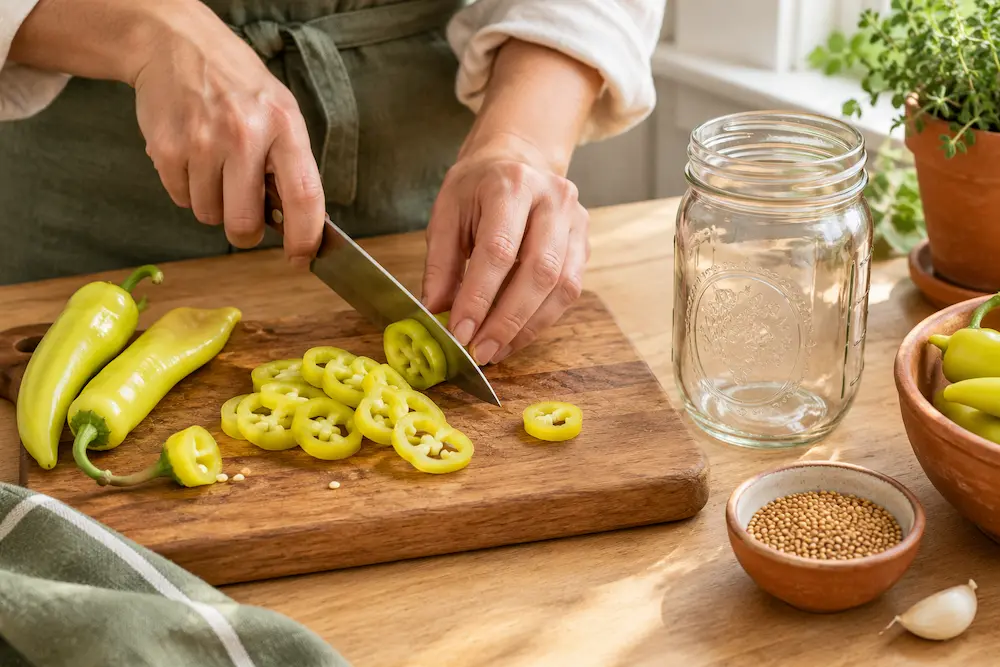
- Pack the jar. Put the garlic, mustard seeds, peppercorns, and bay leaf (if using) in the bottom, then pack in the pepper rings and press them down firmly. They should be snug but not crushed. Leave about 1/2 inch of space at the top.
- Make the brine. Combine the vinegar, water, salt, and sugar in your saucepan. Bring to a simmer, stirring until the salt and sugar dissolve, then take it off the heat. It does not need a hard boil.
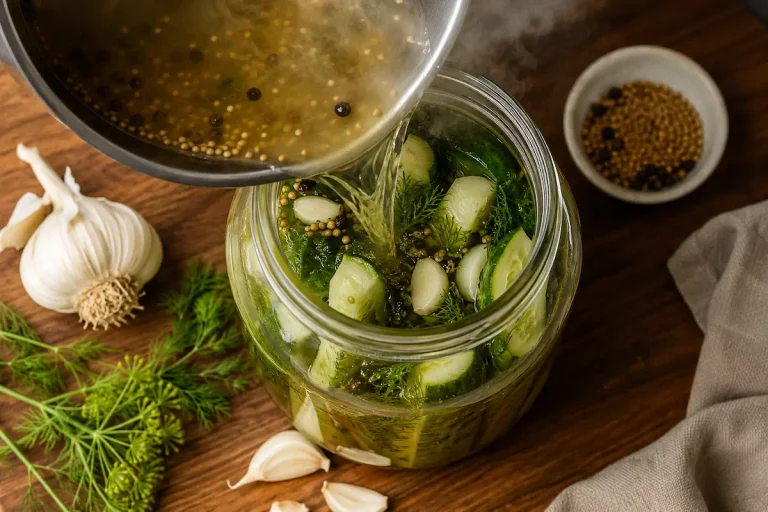
- Pour the brine. Pour slowly over the peppers, since hot liquid poured fast can crack glass. Every ring needs to be under the surface, because anything poking out of the brine is where spoilage starts. Tap the jar or slide a clean chopstick down the side to release air bubbles. If you come up short, mix a small extra batch at the same ratio (1/4 cup vinegar, 1/4 cup water, 3/4 teaspoon pickling salt) and top it up. Do not top up with plain water, which dilutes the brine.
- Cool briefly. Let the jar sit uncovered on the counter for about 30 minutes, until it is no longer steaming hot, then put the lid on. Do not leave it out for more than 2 hours total before refrigerating.
- Refrigerate. Put the jar in the fridge and write the date on the lid. Give it a gentle shake once a day for the first 2 to 3 days so the brine distributes evenly.
Pouring the brine hot gives you faster flavor at the cost of a slightly softer ring. If crunch matters most, let the brine cool for 10 to 15 minutes before you pour, and expect to wait a day or two longer for the peppers to taste pickled.
When Pickled Banana Peppers Are Ready
Sliced into rings, pickled banana peppers taste pickled after about 24 hours, and the flavor keeps deepening over the next few days. Day 3 to 5 is a good target if you want the best balance of tang and crunch. Whole peppers and thick cuts take longer, since the brine has to work its way to the center. Taste one ring at the 24-hour mark and decide from there.
Why This Brine Ratio Works
Equal parts vinegar and water gives a brine that is tangy without being harsh, and it is the ratio we use for most of our refrigerator pickles, including these pickled banana peppers. The vinegar supplies the acid, the salt seasons the peppers and helps them stay firm, and a little sugar softens the sharp edge without turning the jar into a sweet pickle. For a deeper look at how each ingredient changes the result, see our pickle brine guide.
Two rules hold no matter how you adjust the flavor. Use vinegar labeled 5% acidity, and do not dilute the brine beyond 1:1 to make a milder pickle. For a gentler taste, add a bit more sugar or trim the salt slightly instead. Distilled white vinegar gives the cleanest flavor, while apple cider vinegar at 5% also works and makes a darker, fruitier brine.
Keeping Pickled Banana Peppers Crisp
Soft rings almost always trace back to one of four causes, and each has a simple fix:
- Tired peppers. Peppers soften as they sit, so buy them close to pickling day and choose the firmest ones.
- Thin or uneven cuts. Thin rings go limp sooner. Stay near 1/4 inch and keep the thickness consistent.
- Cooking the peppers. Pour the hot brine over the peppers in the jar instead of simmering the peppers in the pot.
- Very hot brine. The cooler the brine when it hits the peppers, the crunchier the result, at the cost of slower flavor.
For extra insurance, some cooks add a calcium chloride crisping product. If you use one, follow the label for the amount per quart.
Scaling Pickled Banana Peppers for Other Jar Sizes
The ratio for pickled banana peppers stays the same at any size: equal parts vinegar and water, with 1 tablespoon of pickling salt for every 2 cups of total liquid.
| Jar size | Vinegar | Water | Pickling salt | Peppers (approx.) |
|---|---|---|---|---|
| Pint (16 oz) | 1/2 cup | 1/2 cup | 1 1/2 teaspoons | 1/2 lb (4 to 5 medium) |
| Quart (32 oz) | 1 cup | 1 cup | 1 tablespoon | 1 lb (8 to 10 medium) |
| Half-gallon (64 oz) | 2 cups | 2 cups | 2 tablespoons | 2 lb (16 to 20 medium) |
If you use a different salt, weigh it instead of measuring by volume. Never scale down the vinegar to make a milder pickle.
Variations
Once the base pickled banana peppers are down, the flavorings are where you can experiment. The brine ratio is the part to keep consistent.
- Sweeter: stir in up to 3 tablespoons of sugar while the brine heats, for a jar closer to the sweet pepper rings sold at sandwich shops.
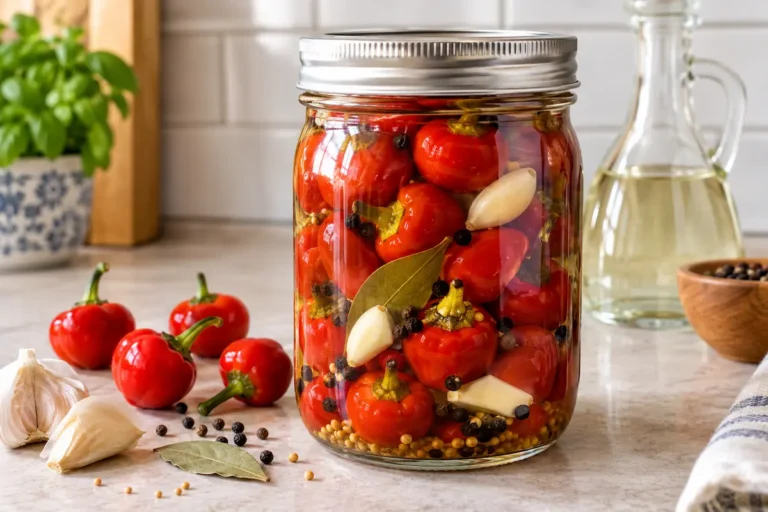
- Extra hot: use hot banana peppers, or add a few jalapeno slices or a pinch of red pepper flakes. Our pickled cherry peppers use the same refrigerator method if you want a second pepper in the fridge.
- Garlic and herb: double the garlic and add a pinch of dried oregano for an Italian deli flavor.
- Whole peppers: pierce each pepper a couple of times with a knife tip so the brine can reach the inside, and plan on closer to a week before they taste pickled all the way through.
Can You Can Pickled Banana Peppers?
Not with this recipe. The 1:1 brine here is built for the refrigerator. Shelf-stable pickled peppers are a different product: they need a tested canning recipe, and for hot and banana peppers those recipes use a considerably higher proportion of vinegar than this one, along with specific jar preparation and processing times. Do not process this recipe in a water bath, and do not store it at room temperature. If you want shelf-stable pickled peppers, follow a tested recipe from the National Center for Home Food Preservation exactly as written.
Troubleshooting Pickled Banana Peppers by Symptom
Soft or limp pickled banana peppers. See the crisping section above. The usual culprits are older peppers, thin slices, simmering the peppers, or very hot brine.
Cloudy brine. Often caused by salt with anti-caking additives, minerals in hard water, or sediment from garlic and spices. If the peppers look normal and smell clean, it is cosmetic. Cloudiness together with fizzing, slime, or an off smell is a different story (see below).
Blue or green garlic. Garlic can turn blue or green in acidic brine, especially young garlic. It is a harmless color reaction and does not mean the jar has spoiled.
Fizzing, rising bubbles, a yeasty smell, slime, or fuzz. Throw the jar out. Unplanned fermentation or spoilage can look and smell like this, and it is not worth tasting to find out.
Too sharp. Add another tablespoon of sugar to the next batch, or let this jar rest a few more days. Do not cut the vinegar.
Too salty. On the next batch, trim the salt by about a third (2 teaspoons instead of 1 tablespoon) and keep the vinegar-to-water ratio the same.
Rings floating above the brine. Pack the jar tighter next time and top up with extra brine mixed at the same ratio, so every ring stays submerged.
Storing Pickled Banana Peppers
Keep your pickled banana peppers in the fridge the entire time, with the rings fully under the brine and the lid on. Plan to finish the jar within about 2 to 4 weeks. This recipe has not been lab-tested for a specific maximum storage period, and some extension guidance for unprocessed refrigerator pickles is as short as 2 weeks, so the earlier end is the cautious plan. Use a clean fork each time instead of reaching in with your fingers.
Discard the jar if you see mold, slime, fizzing, or a mushy texture, or if it smells off. A jar that passes the sniff test is not automatically safe, so when in doubt, throw it out.
Ways to Use Pickled Banana Peppers
The obvious home is a sandwich or sub, but pickled banana peppers earn their jar space in plenty of other places. Scatter them over pizza and flatbreads, chop them into tuna, egg, or pasta salad, tuck them into tacos and nachos, or add them to a cheese board. A spoonful of the brine adds tang to salad dressings and marinades, too. If you are building out a small-space pantry, our guide to apartment homesteading covers more projects that work in a rental kitchen.
Frequently Asked Questions
Do I need to can pickled banana peppers?
Not for this recipe. It is a refrigerator pickle, so it stays in the fridge and does not need a water bath. For shelf-stable peppers you need a tested canning recipe, and this one is not it.
How long do pickled banana peppers last in the fridge?
Plan to finish the jar within about 2 to 4 weeks, keeping the rings submerged and the jar cold. Always check for mold, sliminess, or an off smell before eating.
Can I use hot banana peppers?
Yes, the recipe is the same. Taste a raw slice first so you know what you have, and wear gloves if the peppers are on the hotter side.
Do I have to remove the seeds?
No. The seeds add a little heat and some texture. For a milder jar, scrape out the seeds and the white membranes, where much of the heat sits.
Why did my pickled banana peppers go soft?
Usually the peppers were past their best, the slices were thin, or the peppers were cooked in the brine instead of just covered with it. Letting the brine cool a few minutes before pouring also helps.
Can I reuse the brine?
Not for another batch of pickles. Once brine has sat with the peppers it has picked up water and flavor, which makes it less reliable. Mix fresh brine each time.
Can I use apple cider vinegar instead of white vinegar?
Yes, as long as the label says 5% acidity. It gives a fruitier flavor and a darker brine.
Can I pickle whole banana peppers?
Yes. Pierce each pepper a couple of times so the brine can get inside, and give them closer to a week before tasting.