Is Apartment Homesteading Worth It? An Honest Look at Cost & Time
Is Apartment Homesteading Worth It? An Honest Look
Somewhere between growing herbs on a windowsill and watching a sourdough starter for the third day in a row without a rise, most apartment homesteaders eventually ask the same question: is this actually worth it?
It’s a fair question. Apartment homesteading takes counter space, time, and a fair amount of trial and error — and unlike a backyard homestead with an acre of garden, the payoff can look small by comparison. Here’s the honest answer: yes, but not primarily as a money-saving strategy. It’s worth it when you pick projects you’ll actually use, keep the setup small, and value the skills and food quality alongside whatever you save. The rest of this article breaks down exactly what that means in practice.
What Does “Worth It” Actually Mean?
Apartment homesteading rarely pays for itself the way a large backyard garden might — a windowsill herb pot isn’t going to meaningfully cut your grocery bill on its own. The value shows up across four different things instead: financial savings, time invested, skills gained, and the satisfaction of making or growing something yourself. A project can score low on one of these and still be worth doing if it scores high on another — which is really the core idea behind everything that follows.
How Much Does Apartment Homesteading Cost?
Startup Costs
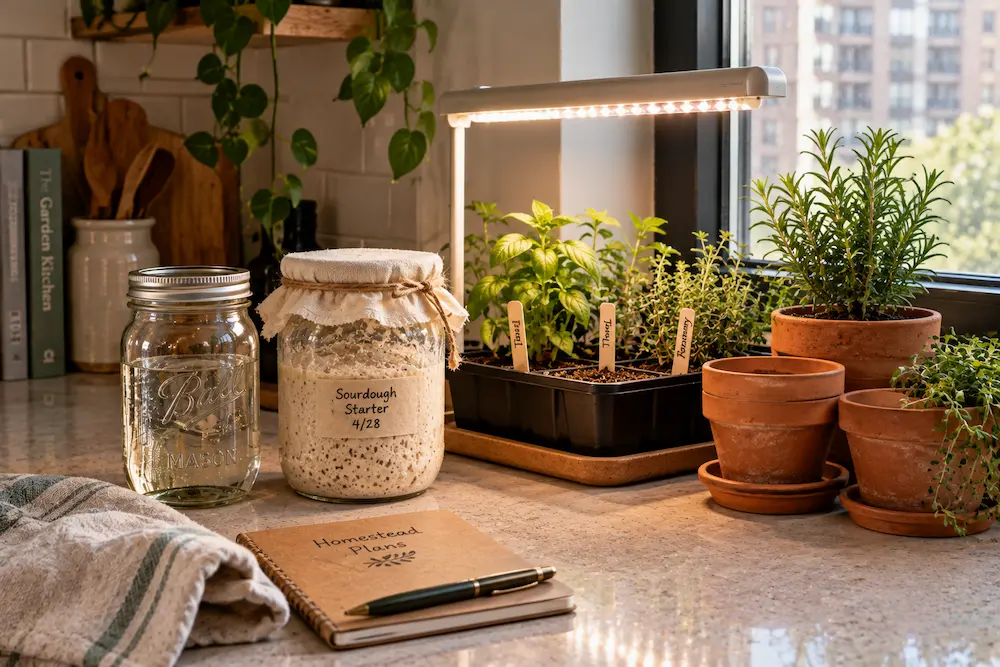
Most beginner projects have a modest one-time setup cost — pots and soil for herbs, jars and salt for fermenting, flour and a jar for a sourdough starter. Exact amounts vary widely by what you already own and where you shop, but the general pattern holds across projects: the entry cost is low compared to most hobbies, and you can start with just one project rather than buying everything at once.
Ongoing Costs
Ongoing costs tend to be small and predictable — flour for regular baking, occasional replacement soil or salt, new jar lids now and then. None of these add up to a significant recurring expense on their own.
The Cost of Your Time: Active vs. Elapsed
This is the cost people underestimate most, and it helps to separate two different things: active time (the minutes you’re actually doing something) and elapsed time (how long a process occupies your attention overall). A sourdough loaf might occupy the better part of a day between mixing, folding, and baking, but only a fraction of that is genuinely hands-on — most of it is waiting. Fermenting vegetables is similar: a jar might sit on the counter for a week, but it only needs a minute or two of actual attention each day. A small setup with a few herb pots, one fermenting jar, and a sourdough starter typically needs only a few minutes of active time on most days, with baking day being the exception where hands-on work can add up to an hour or more.
The Cost of Space
Every project competes for the same limited counter and windowsill space, and how much you can realistically take on depends heavily on your specific apartment. A unit with a bright, sunny kitchen window can support several herb pots and maybe a small grow light setup; a dark studio with no direct sun makes indoor growing considerably harder, even if fermenting and baking are unaffected by light at all. For many beginners, two or three ongoing projects is enough before space and attention start to feel stretched.
Cost & Time at a Glance
| Project | Setup Cost | Ongoing Cost | Typical Maintenance |
|---|---|---|---|
| Windowsill herbs | Low | Low | Brief regular maintenance |
| Vegetable ferments | Very low | Very low | A minute or two per check-in |
| Sourdough | Low | Low–moderate | Regular starter care, plus active baking days |
| Reusable household swaps | Low | Very low | Almost none after setup |
| Apartment composting | Low–moderate | Low | Regular, ongoing attention |
These are relative ranges rather than fixed prices, since actual costs vary by location, what you already own, and how you shop — but the comparison holds regardless of where you live.
How Much Can Apartment Homesteading Actually Save?
The savings are real but concentrated in specific categories rather than spread evenly across your grocery bill. Fermented foods can be significantly cheaper to make at home, particularly compared to specialty or premium store-bought versions, since you’re mostly paying for vegetables plus salt and time rather than packaging and markup. Fresh herbs are one of the easier categories to save on, especially since store-bought bunches often go half-used before they spoil, while a windowsill plant provides a repeated supply from a single upfront cost. Sourdough bread saves less than people expect once flour and occasional failed loaves are factored in, but many people prefer the flavor, texture, and control of homemade bread regardless of the exact savings.
Not every project will save money in practice: failed batches, dead plants, unused ingredients, and replacement supplies are a normal part of the learning curve, and they eat into the savings until the routine settles in.
For many people, the result is savings that are modest but genuinely noticeable — not the kind that transforms a grocery budget on their own, but enough to matter over months of regular use.
Which Projects Give You the Best Return on Time and Money?
Different projects pay off in different ways, which is often more useful to know than a single overall verdict.
Windowsill herbs — often the best financial payoff. Low cost, low space, and frequent use if you cook often make this one of the fastest ways to see a return, though results depend on how much you actually cook with fresh herbs.
Fermented vegetables — best skill-to-cost ratio. Cheap ingredients, and the process teaches fermentation fundamentals that carry over into other projects.
Homemade sourdough — best quality payoff. Savings are moderate at best, but many people prefer the flavor, texture, and control of homemade bread over most store-bought loaves.
Reusable household swaps — best long-term payoff. Items like DIY reusable paper towels cost a little upfront and then keep paying off with almost no ongoing time investment.
Apartment composting — best waste-reduction payoff. The financial return is modest, but for anyone motivated by reducing what goes into the trash, projects like composting in an apartment deliver real value that just isn’t measured in dollars.
What You Get Besides Financial Savings
Beyond the numbers, a few things keep people doing this long after the novelty of a first ferment or first loaf wears off. Skills like maintaining a starter, fermenting safely, or keeping herbs alive indoors get easier every time and carry over if you eventually move somewhere with more space. Homemade ferments and bread give you more control over ingredients, flavor, and preparation than most store-bought equivalents. Projects that reuse scraps — turning fruit peels into vinegar, feeding a compost bin with kitchen waste — cut down on what goes straight into the trash, which matters to a lot of people who start homesteading for environmental reasons in the first place. And for many, there’s a straightforward satisfaction in making or growing something yourself that doesn’t show up on a spreadsheet but is often the actual reason people stick with it.
Who Is Apartment Homesteading Worth It For?
It tends to be genuinely worth it for people who already cook regularly and would use the herbs, ferments, or bread they produce rather than letting them go to waste, people who enjoy the process itself rather than only measuring success in dollars saved, and people building toward a larger homestead someday who want to learn core skills first in a lower-stakes setting.
When Isn’t It Worth It?
It’s a harder case to make if you rarely cook at home, since even the best homegrown herbs or homemade ferments only pay off if you actually use them. It’s also a weaker fit if you don’t have reliable natural light for plants and aren’t interested in a grow light workaround, if you dislike routine daily or weekly maintenance tasks, if you’re taking it on purely to save money rather than for any of the other payoffs, or if you try to start several projects at once rather than one or two — overcommitting early is one of the more common reasons people burn out on this before giving it a fair chance.
How to Start Without Overcommitting
The most common way people burn out on this is starting too many projects at once — our complete apartment homesteading guide covers that mistake in more detail, along with the others worth avoiding. The practical fix here is simple: pick one project, actually use it for a few weeks, and only add the next once the first feels routine. A windowsill herb garden is usually the easiest entry point, since it needs only minutes of attention a week and shows a payoff within weeks.
So, Is Apartment Homesteading Worth It?
Yes — when you treat it as a combination of small savings, useful skills, better control over what you eat, and enjoyment, rather than as a shortcut to a dramatically lower grocery bill. Start with one project you know you’ll actually use, keep the setup small, and expand only once the first project genuinely fits your routine. That’s what makes apartment homesteading sustainable, rather than another hobby that quietly takes over your kitchen.
Frequently Asked Questions
Which apartment homesteading projects actually save the most money?
Fermented foods and fresh herbs tend to save the most, since you’re mostly paying for ingredients rather than packaging and markup. Sourdough and reusable swaps save less on their own but add almost no ongoing cost — see the project-by-project breakdown above for how each one compares.
Can apartment homesteading really save enough money to matter?
A single project on its own — one herb pot, one jar of ferment — won’t move the needle much. But several habits running together, sustained over months, add up to savings that are genuinely noticeable even if they’re not dramatic. The bigger value for most people ends up being the combination of modest savings plus better food quality and skills, not the financial savings alone.
How does the time cost actually break down day to day?
Most of it is elapsed time, not active time — a fermenting jar can sit on the counter for a week but only needs a minute or two of actual attention each day. On an active-time basis, a small setup of herbs, one ferment, and a sourdough starter needs just a few minutes on most days, with baking day the exception at an hour or more of hands-on work.
Is apartment homesteading worth it if I don’t cook much?
It’s a harder case to make — most of the value comes from actually using what you grow or ferment, so infrequent cooks tend to get less out of it relative to the time invested.
What’s the best apartment homesteading project to start with?
A windowsill herb garden is generally the lowest-effort, fastest-payoff starting point for most people, though the exact results depend on how much natural light your space gets.
Can apartment homesteading work in a very small studio?
Many beginner projects can be adapted to small spaces, though the practical limit depends on your available counter, windowsill, storage, and light conditions — a bright studio can support more than a dark one.